



EarthBound
REPLACEMENT LONGPLAY
| 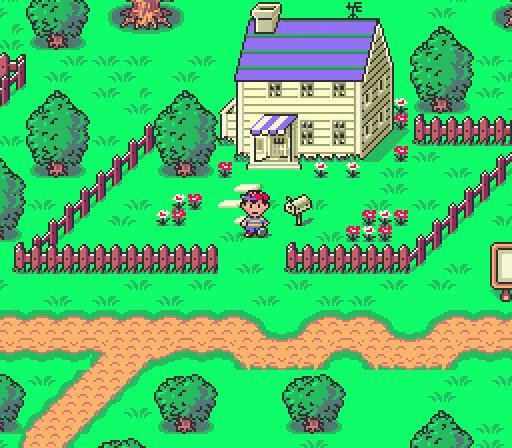
Screenshot |


Player's Review
Set in a fictional version of 1990's USA, the game follows a young boy named Ness as he uses his psychic powers to put an end to the paranormal phenomena spiralling the world into disarray.
EarthBound, known in Japan as Mother 2: Giigu no Gyakushuu, is a role-playing game developed by Ape and HAL Laboratory and published by Nintendo for the SNES in 1994 and in the North American region in 1995. It is the second game in the Mother series, following EarthBound Beginnings and preceding Mother 3. Mother 2 is the second title of the Mother series, which was originally not well known in the mainstream media, but gained a large cult following on the Internet, and heavily influenced such independently developed games as Yume Nikki, OFF, Lisa: the Painful, Undertale and many others.
Development began shortly after the release of Mother, running aground several times along with the project repeatedly facing threats of cancellation; it wasn't until HAL Laboratory president Satoru Iwata stepped in that Mother 2 began to see an eventual release. Releasing to critical acclaim in Japan, Mother 2 was released in the United States under the name EarthBound and was backed up by a massive advertising campaign. The game was a critical and commercial failure, however, owning to criticism directed toward the game's satirical marketing campaign based on gross-out humor and its art direction amidst RPGs like Chrono Trigger and Final Fantasy VI. It was only with the emergence of internet fan-community efforts that EarthBound regained relevance in the US. On April 20, 2006, a sequel titled Mother 3 was released on the Game Boy Advance, exclusively in Japan.
Mother composers Keiichi Suzuki and Hirokazu Tanaka returned to make the EarthBound soundtrack, along with newcomers Hiroshi Kanazu and Toshiyuki Ueno. In comparison with Mother, Itoi said that EarthBound had more "jazzy" pieces. According to Tanaka, the soundtrack is mainly inspired by songs from the rock band Beach Boys, as well as music by Randy Newman and Harry Nilsson, among many other inspirations.
The game's story is largely distinct from that of its predecessor, but there are multiple elements and characters that connect the two games, sometimes to the point that Earthbound feels like a remastered rerelease of Earthbound Beginnings, while still being a sequel in terms of plot. Most notably, Giegue, renamed Giygas in the English version of EarthBound, reprises his role as the main antagonist from EarthBound Beginnings. The main quest also consists of gathering melodies to form a song, just like in the first game. The main cast of characters also once again consists of a boy with a baseball bat and healing spells, a girl with a frying pan and offensive spells, a glasses-wearing boy with guns and gadgets and a stern boy with a sword who joins the party rather late and then leaves. You also get to walk around with a giant ally who one-shots enemies a little, who then gets dramatically removed from the party. And so on. A distinct difference from the first game is the introduction of a character named Pokey ( Porky in the Japanese version ), who serves as a kind of a dark reflection of the game's protagonist, showing the difference that good or bad upbringing can make. This character concept was further developed in Mother 3.
This video game trilogy is notable for being one of very few in its era that had an actual professional writer behind its dialogue script and story. Mother series was designed and directed by famed Japanese copywriter and television personality Shigesato Itoi. It was named after John Lennon's song "Mother". Itoi could heavily relate to the song, which dealt with Lennon's experiences growing up without either of his parents; Itoi's own father was absent for much of his life. Because of this, he chose to isolate the role of Ninten's father as simply a voice on a telephone, a role that would be inherited by Ness's father in EarthBound. Another reason for choosing such title was its connection to the word "mothership", since alien invasion was a major event in the first game. The artstyle of the overworld sprites were derived from the Peanuts comic series. Itoi also felt that "Mother" was a fitting title for the game, as it was noticeably more "feminine" than most RPGs. Throughout the whole trilogy, one of the main themes in designing those games was subverting players' expectations. Similar to first game in the series, Itoi took a "masculine" genre of medieval fantasy dungeon-crawling RPGs dominated by games like Dragon Quest and tried to turn it into an emotional, "feminine" game where events take place in an offbeat parody of present-day America, where the player controls a sad chubby kid with a baseball bat and where the genre does not singularly adhere to fantasy or science fiction tropes, eventually reaching the final boss who you are not even supposed to fight in order to win. Also particularly in case of EarthBound, the entirety of the final section of the game is a big twist, which plays with the players' established expectation of Earthbound being very similar to Earthbound Beginnings the entire time, only to hit its audience with a sudden crisis full of mystery and eldritch horror. The main characters, children, are told to sacrifice themselves in order to even attempt the final battle, and the game does a good job of making you think that the kids will not come back; the melodies you were collecting the whole game are not used to defeat the final boss like the last time, and instead turn out to be rather useless, since the power boost they provide is not enough to beat Giygas directly; the final battle is won not through stats, equipment, special attacks and not even through song, but through the returned kindness and love of everyone you helped, as well as the love of the player herself; the barely important fat side character who mostly seems to exist as comic relief turns out to be a villain who abruptly usurps the position of the main antagonist of the series near end of the game; the final battle itself has some disturbing imagery which created many discussions and theories ( some say Giygas is trying to possess Ness' fetus to prevent the hero who can stop him from being born, others speculate that Giygas reaches the final stage of his psychological descent, similar to certain events of Mother 3, enclosing himself into a womb-like machine that renders him completely invulnerable to any physical or emotional harm from the surrounding world which he fears and doesn't understand, but also rendering him completely isolated, while Shigesato Itoi himself said that the battle is supposed to look bizarre and was inspired by a fuzzy memory about a murder scene in a movie he saw as a kid that he mistook for a rape scene, which traumatized him ) ; the main enemy does not show any arrogance or hate, but openly fears you throughout the whole game and screams in pain during battle, begging you to stop and to be friends ( while trying to kill/possess you ) ; the final boss music starts sounding like a rather standard NES tune, but then suddenly breaks into a heavy metal SNES melody ; and through the whole final section of the game, weirdly distorted fanfare tunes play in the overworld and when Giygas in unleashed, as if to mock the very idea of a group of young heroes facing down a godlike evil being in an epic battle of sword and sorcery.
In this longplay, I try to show everything there is in the game. Because some loot drops are difficult to get without precise RAM manipulation, you will see that I walk back and forth in a few sections of the video trying to get a specific drop, although I tried to keep these farming sessions to a minimum ( usually around 20 minutes each, but the final grind for the Gutsy Bat took about twice as long ). There are many extra scenes edited in at the end, as usual.
EarthBound, known in Japan as Mother 2: Giigu no Gyakushuu, is a role-playing game developed by Ape and HAL Laboratory and published by Nintendo for the SNES in 1994 and in the North American region in 1995. It is the second game in the Mother series, following EarthBound Beginnings and preceding Mother 3. Mother 2 is the second title of the Mother series, which was originally not well known in the mainstream media, but gained a large cult following on the Internet, and heavily influenced such independently developed games as Yume Nikki, OFF, Lisa: the Painful, Undertale and many others.
Development began shortly after the release of Mother, running aground several times along with the project repeatedly facing threats of cancellation; it wasn't until HAL Laboratory president Satoru Iwata stepped in that Mother 2 began to see an eventual release. Releasing to critical acclaim in Japan, Mother 2 was released in the United States under the name EarthBound and was backed up by a massive advertising campaign. The game was a critical and commercial failure, however, owning to criticism directed toward the game's satirical marketing campaign based on gross-out humor and its art direction amidst RPGs like Chrono Trigger and Final Fantasy VI. It was only with the emergence of internet fan-community efforts that EarthBound regained relevance in the US. On April 20, 2006, a sequel titled Mother 3 was released on the Game Boy Advance, exclusively in Japan.
Mother composers Keiichi Suzuki and Hirokazu Tanaka returned to make the EarthBound soundtrack, along with newcomers Hiroshi Kanazu and Toshiyuki Ueno. In comparison with Mother, Itoi said that EarthBound had more "jazzy" pieces. According to Tanaka, the soundtrack is mainly inspired by songs from the rock band Beach Boys, as well as music by Randy Newman and Harry Nilsson, among many other inspirations.
The game's story is largely distinct from that of its predecessor, but there are multiple elements and characters that connect the two games, sometimes to the point that Earthbound feels like a remastered rerelease of Earthbound Beginnings, while still being a sequel in terms of plot. Most notably, Giegue, renamed Giygas in the English version of EarthBound, reprises his role as the main antagonist from EarthBound Beginnings. The main quest also consists of gathering melodies to form a song, just like in the first game. The main cast of characters also once again consists of a boy with a baseball bat and healing spells, a girl with a frying pan and offensive spells, a glasses-wearing boy with guns and gadgets and a stern boy with a sword who joins the party rather late and then leaves. You also get to walk around with a giant ally who one-shots enemies a little, who then gets dramatically removed from the party. And so on. A distinct difference from the first game is the introduction of a character named Pokey ( Porky in the Japanese version ), who serves as a kind of a dark reflection of the game's protagonist, showing the difference that good or bad upbringing can make. This character concept was further developed in Mother 3.
This video game trilogy is notable for being one of very few in its era that had an actual professional writer behind its dialogue script and story. Mother series was designed and directed by famed Japanese copywriter and television personality Shigesato Itoi. It was named after John Lennon's song "Mother". Itoi could heavily relate to the song, which dealt with Lennon's experiences growing up without either of his parents; Itoi's own father was absent for much of his life. Because of this, he chose to isolate the role of Ninten's father as simply a voice on a telephone, a role that would be inherited by Ness's father in EarthBound. Another reason for choosing such title was its connection to the word "mothership", since alien invasion was a major event in the first game. The artstyle of the overworld sprites were derived from the Peanuts comic series. Itoi also felt that "Mother" was a fitting title for the game, as it was noticeably more "feminine" than most RPGs. Throughout the whole trilogy, one of the main themes in designing those games was subverting players' expectations. Similar to first game in the series, Itoi took a "masculine" genre of medieval fantasy dungeon-crawling RPGs dominated by games like Dragon Quest and tried to turn it into an emotional, "feminine" game where events take place in an offbeat parody of present-day America, where the player controls a sad chubby kid with a baseball bat and where the genre does not singularly adhere to fantasy or science fiction tropes, eventually reaching the final boss who you are not even supposed to fight in order to win. Also particularly in case of EarthBound, the entirety of the final section of the game is a big twist, which plays with the players' established expectation of Earthbound being very similar to Earthbound Beginnings the entire time, only to hit its audience with a sudden crisis full of mystery and eldritch horror. The main characters, children, are told to sacrifice themselves in order to even attempt the final battle, and the game does a good job of making you think that the kids will not come back; the melodies you were collecting the whole game are not used to defeat the final boss like the last time, and instead turn out to be rather useless, since the power boost they provide is not enough to beat Giygas directly; the final battle is won not through stats, equipment, special attacks and not even through song, but through the returned kindness and love of everyone you helped, as well as the love of the player herself; the barely important fat side character who mostly seems to exist as comic relief turns out to be a villain who abruptly usurps the position of the main antagonist of the series near end of the game; the final battle itself has some disturbing imagery which created many discussions and theories ( some say Giygas is trying to possess Ness' fetus to prevent the hero who can stop him from being born, others speculate that Giygas reaches the final stage of his psychological descent, similar to certain events of Mother 3, enclosing himself into a womb-like machine that renders him completely invulnerable to any physical or emotional harm from the surrounding world which he fears and doesn't understand, but also rendering him completely isolated, while Shigesato Itoi himself said that the battle is supposed to look bizarre and was inspired by a fuzzy memory about a murder scene in a movie he saw as a kid that he mistook for a rape scene, which traumatized him ) ; the main enemy does not show any arrogance or hate, but openly fears you throughout the whole game and screams in pain during battle, begging you to stop and to be friends ( while trying to kill/possess you ) ; the final boss music starts sounding like a rather standard NES tune, but then suddenly breaks into a heavy metal SNES melody ; and through the whole final section of the game, weirdly distorted fanfare tunes play in the overworld and when Giygas in unleashed, as if to mock the very idea of a group of young heroes facing down a godlike evil being in an epic battle of sword and sorcery.
In this longplay, I try to show everything there is in the game. Because some loot drops are difficult to get without precise RAM manipulation, you will see that I walk back and forth in a few sections of the video trying to get a specific drop, although I tried to keep these farming sessions to a minimum ( usually around 20 minutes each, but the final grind for the Gutsy Bat took about twice as long ). There are many extra scenes edited in at the end, as usual.
No Comments have been Posted.