



Conquests of Camelot: The Search for the Grail
Conquests of Camelot: The Search for the Grail, developed and published by Sierra in 1990.
| 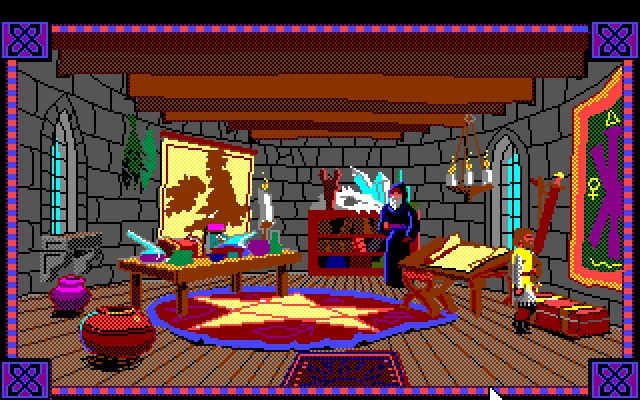
Screenshot |


Player's Review
"The holy GRAIL - It is the most famous and sought-after object in the world. It is the stuff that dreams and legends are made of. It is the one thing that will heal the heart of a king and breathe life into a dying land. More than all these things, it is a symbol of the trials of body, mind and spirit that all people face in their search for meaning and truth. Come with us to Camelot as the legendary King Arthur sets out on his ultimate quest."
From Wiki:-
"The gameplay is typical of the Sierra adventure games of that time, including several action sequences, puzzles and riddles. Occasionally, some alternative solutions to puzzles are available.
Scoring is based on three kinds of points: Skill (when the player performs deeds that help him in his quest, or defeats enemies), Wisdom (when examining things, talking to others, or gaining hints) and Soul (performing good deeds to help others). The options provide a difficulty setting for the action sequences, but with lower points. The game features a soundtrack of authentic-sounding medieval music composed by Mark Seibert.
The message boxes (narration) are the wizard Merlin speaking and counseling the player. The in-game text displays lesser-known forms of words, for example Gwenhyver, Excaliber, Gawaine, Launcelot, and magick instead of the better-known Guinevere, Excalibur, Gawain, Lancelot, and magic. The parser, however, understands all spellings."
For this longplay, I'm typically not a fan of this style of adventure game, especially as dangers lurk every ware with the intent of killing you so saving occasionally is a must. So I am executing the guide from "The Sierra Chest" but not just simply copy and pasting the run as I do try to show other other things you can interact with but I may not have caught every possible bit of dialogue. Sometimes it will appear solutions are just known and not found and this is due to needed info in the games manual and additional materials. Having to type in commands and hope it acknowledges them also put me off this style of game and much prefer the Lucasarts point ands click system. The overall intent is to have the highest possible scores at the end.
Sierra adventure games can be quite taxing on a stock Amiga 500 so am using an A1200 config for added performance. I show a few of the death sequences at the end that I came across but it's by no means all of them. The game comes on six disks requiring a minimum of one mb of ram.
00:00:00 Intro
00:07:10 Camelot
00:31:55 Glastonbury
00:58:33 OT Moor
01:09:25 Southampton
01:13:21 Gaza
01:32:34 Bazaar of Jerusalem
02:07:00 Fatima
02:17:00 Catacombs
02:33:13 Temple
02:45:40 Ending
02:50:56 Death Scenes
From Wiki:-
"The gameplay is typical of the Sierra adventure games of that time, including several action sequences, puzzles and riddles. Occasionally, some alternative solutions to puzzles are available.
Scoring is based on three kinds of points: Skill (when the player performs deeds that help him in his quest, or defeats enemies), Wisdom (when examining things, talking to others, or gaining hints) and Soul (performing good deeds to help others). The options provide a difficulty setting for the action sequences, but with lower points. The game features a soundtrack of authentic-sounding medieval music composed by Mark Seibert.
The message boxes (narration) are the wizard Merlin speaking and counseling the player. The in-game text displays lesser-known forms of words, for example Gwenhyver, Excaliber, Gawaine, Launcelot, and magick instead of the better-known Guinevere, Excalibur, Gawain, Lancelot, and magic. The parser, however, understands all spellings."
For this longplay, I'm typically not a fan of this style of adventure game, especially as dangers lurk every ware with the intent of killing you so saving occasionally is a must. So I am executing the guide from "The Sierra Chest" but not just simply copy and pasting the run as I do try to show other other things you can interact with but I may not have caught every possible bit of dialogue. Sometimes it will appear solutions are just known and not found and this is due to needed info in the games manual and additional materials. Having to type in commands and hope it acknowledges them also put me off this style of game and much prefer the Lucasarts point ands click system. The overall intent is to have the highest possible scores at the end.
Sierra adventure games can be quite taxing on a stock Amiga 500 so am using an A1200 config for added performance. I show a few of the death sequences at the end that I came across but it's by no means all of them. The game comes on six disks requiring a minimum of one mb of ram.
00:00:00 Intro
00:07:10 Camelot
00:31:55 Glastonbury
00:58:33 OT Moor
01:09:25 Southampton
01:13:21 Gaza
01:32:34 Bazaar of Jerusalem
02:07:00 Fatima
02:17:00 Catacombs
02:33:13 Temple
02:45:40 Ending
02:50:56 Death Scenes
No Comments have been Posted.