



Mother 3 (Fan Translation)
| 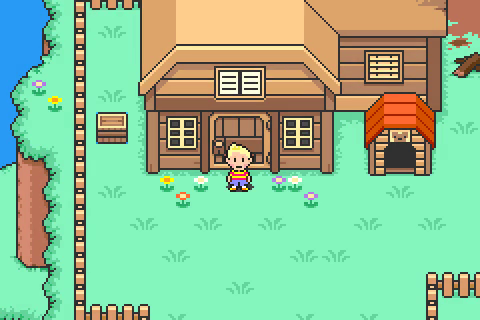
Screenshot |


Player's Review
Set on fictional Nowhere Islands, the game follows a young boy named Lucas and his friends as they try to stop the mysterious Pigmask Army from corrupting their peaceful village.
Mother 3 is a role-playing video game for the Game Boy Advance, developed by HAL Laboratory and Brownie Brown and published by Nintendo for the Japanese market in 2006. It is the third and final video game in the Mother series, known as EarthBound outside Japan, which was originally not well known in the mainstream media, but gained a large cult following on the Internet, and heavily influenced such independently developed games as Yume Nikki, OFF, Lisa: the Painful, Undertale and many others. Mother 3's development spanned twelve years and four consoles, beginning in 1994 as a game for the Super Famicom and then transitioning to 3D for the Nintendo 64, when it was known as EarthBound 64, then being planned to be a launch title for N64's 64DD add-on, then getting cancelled due to add-on's commercial failure and the shifting of funds towards development of Nintendo GameCube, and finally being released in 2D on the GBA. In June 2003 during a Mother 1+2 television commercial, the game was announced to be in development for the Game Boy Advance and then released to great success. Later, project leader Shigesato Itoi stated that there will be no new installments in the Mother series due to how arduous Mother 3's development was for the people involved. As Simon Parkin of Eurogamer has said in his review of Mother 3 in 2008: "few pregnancies have been as painful and protracted as Mother 3's".
An unofficial English fan translation was released by the Starmen.net internet community in 2008 and received over 100,000 downloads within a week. It was estimated that the theoretical freelance cost of the translation was $30,000. In the usual fashion for this franchise's history, former Nintendo of America president Reggie Fils-Aime later said in an interview with Bloomberg News that the absence of English localization of Mother 3 was because it "just didn't make business sense".
Compared to other games in the series, combat in Mother 3 includes a unique musical combo system. When one of the playable characters directly attacks an enemy with a weapon, they can continue to repeatedly attack the enemy by pressing the button in time with the beat of the background music.
This video game trilogy is notable for being one of very few in its era that had an actual professional writer behind its dialogue script and story. Mother series was designed and directed by famed Japanese copywriter and television personality Shigesato Itoi. It was named after John Lennon's song "Mother". Itoi could heavily relate to the song, which dealt with Lennon's experiences growing up without either of his parents; Itoi's own father was absent for much of his life. Another reason for choosing such title was its connection to the word "mothership", since alien invasion was a major event in the first game. Mother 3 in particular is also heavily inspired by the book trilogy Le Grand Cahier (The Notebook) by Hungarian writer Agota Kristof and has many parallels with it, down to the names of the two main characters, twin brothers Lucas and Klaus. The artstyle of the overworld sprites were derived from the Peanuts comic series. Itoi also felt that "Mother" was a fitting title for the game, as it was noticeably more "feminine" than most RPGs. Throughout the whole trilogy, one of the main themes in designing those games was subverting players' expectations. Like in the previous games in the series, Itoi took a "masculine" genre of medieval fantasy dungeon-crawling RPGs dominated by games like Dragon Quest and tried to turn it into an emotional, "feminine" game where events take place in an offbeat parody of the modern world and where the genre does not singularly adhere to fantasy or science fiction tropes, eventually reaching the final boss who you are not even supposed to fight in order to win. Mother 3 in particular is also divided into chapters, similar to Dragon Quest IV. Itoi saw himself as simultaneously making the game he wanted to play and setting traps for the player, and as making a game Nintendo could not. Initially during development, as part of the general theme of subversion of expectations, Itoi intended to change the trend for cheerful tone and happy endings established with the previous two games, and sneak in painful emotional blows on the players instead, ending with a revelation that would "betray the players", although in the final product, the "betrayal" is not as much of a rugpull compared to The Notebook series and the general tone ended up more light-hearted and less gritty than originally intended, while still remaining surprisingly dark at times. During development, Itoi also intended to introduce another significant change in some sort of a morality system for the game that could be interacted with by performing certain actions which would change a character's status on a scale from loving to cold-hearted, which would in turn influence the game's ending. But in the end, it was decided to make the usual game with a linear storyline and clear messages. Mother 3 is also the most linear of the trilogy in terms of progression, especially compared to Mother 1 with its almost open world.
In this longplay, I try to show everything. A lot of extra scenes that couldn't be shown during the playthrough are edited in at the end.
Mother 3 is a role-playing video game for the Game Boy Advance, developed by HAL Laboratory and Brownie Brown and published by Nintendo for the Japanese market in 2006. It is the third and final video game in the Mother series, known as EarthBound outside Japan, which was originally not well known in the mainstream media, but gained a large cult following on the Internet, and heavily influenced such independently developed games as Yume Nikki, OFF, Lisa: the Painful, Undertale and many others. Mother 3's development spanned twelve years and four consoles, beginning in 1994 as a game for the Super Famicom and then transitioning to 3D for the Nintendo 64, when it was known as EarthBound 64, then being planned to be a launch title for N64's 64DD add-on, then getting cancelled due to add-on's commercial failure and the shifting of funds towards development of Nintendo GameCube, and finally being released in 2D on the GBA. In June 2003 during a Mother 1+2 television commercial, the game was announced to be in development for the Game Boy Advance and then released to great success. Later, project leader Shigesato Itoi stated that there will be no new installments in the Mother series due to how arduous Mother 3's development was for the people involved. As Simon Parkin of Eurogamer has said in his review of Mother 3 in 2008: "few pregnancies have been as painful and protracted as Mother 3's".
An unofficial English fan translation was released by the Starmen.net internet community in 2008 and received over 100,000 downloads within a week. It was estimated that the theoretical freelance cost of the translation was $30,000. In the usual fashion for this franchise's history, former Nintendo of America president Reggie Fils-Aime later said in an interview with Bloomberg News that the absence of English localization of Mother 3 was because it "just didn't make business sense".
Compared to other games in the series, combat in Mother 3 includes a unique musical combo system. When one of the playable characters directly attacks an enemy with a weapon, they can continue to repeatedly attack the enemy by pressing the button in time with the beat of the background music.
This video game trilogy is notable for being one of very few in its era that had an actual professional writer behind its dialogue script and story. Mother series was designed and directed by famed Japanese copywriter and television personality Shigesato Itoi. It was named after John Lennon's song "Mother". Itoi could heavily relate to the song, which dealt with Lennon's experiences growing up without either of his parents; Itoi's own father was absent for much of his life. Another reason for choosing such title was its connection to the word "mothership", since alien invasion was a major event in the first game. Mother 3 in particular is also heavily inspired by the book trilogy Le Grand Cahier (The Notebook) by Hungarian writer Agota Kristof and has many parallels with it, down to the names of the two main characters, twin brothers Lucas and Klaus. The artstyle of the overworld sprites were derived from the Peanuts comic series. Itoi also felt that "Mother" was a fitting title for the game, as it was noticeably more "feminine" than most RPGs. Throughout the whole trilogy, one of the main themes in designing those games was subverting players' expectations. Like in the previous games in the series, Itoi took a "masculine" genre of medieval fantasy dungeon-crawling RPGs dominated by games like Dragon Quest and tried to turn it into an emotional, "feminine" game where events take place in an offbeat parody of the modern world and where the genre does not singularly adhere to fantasy or science fiction tropes, eventually reaching the final boss who you are not even supposed to fight in order to win. Mother 3 in particular is also divided into chapters, similar to Dragon Quest IV. Itoi saw himself as simultaneously making the game he wanted to play and setting traps for the player, and as making a game Nintendo could not. Initially during development, as part of the general theme of subversion of expectations, Itoi intended to change the trend for cheerful tone and happy endings established with the previous two games, and sneak in painful emotional blows on the players instead, ending with a revelation that would "betray the players", although in the final product, the "betrayal" is not as much of a rugpull compared to The Notebook series and the general tone ended up more light-hearted and less gritty than originally intended, while still remaining surprisingly dark at times. During development, Itoi also intended to introduce another significant change in some sort of a morality system for the game that could be interacted with by performing certain actions which would change a character's status on a scale from loving to cold-hearted, which would in turn influence the game's ending. But in the end, it was decided to make the usual game with a linear storyline and clear messages. Mother 3 is also the most linear of the trilogy in terms of progression, especially compared to Mother 1 with its almost open world.
In this longplay, I try to show everything. A lot of extra scenes that couldn't be shown during the playthrough are edited in at the end.
No Comments have been Posted.